Standalone, semi-detached, twin, duet, attached: villa brochures in the UAE use a lot of words for a small number of layouts. The difference matters, because it decides how many neighbours share your walls, how much of the plot is yours to use, and how the villa will compare when you sell. This guide sets out what each term means, how developers actually use them, and how to check for yourself.
The three layouts in one picture
Strip away the names and there are three basic arrangements. The diagram shows each one in plan view.
Standalone villa
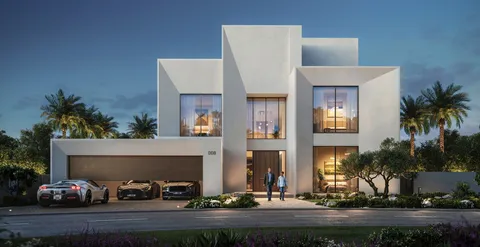
A standalone villa is a detached house on its own plot. It shares no wall with any other home, so there is open space on all four sides. Brochures also call it a detached, independent or private villa.
Semi-detached villa
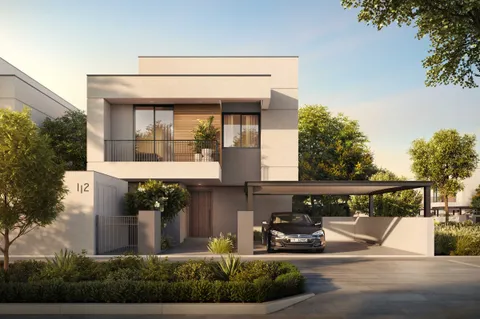
A semi-detached villa is one half of a pair. The two homes share a single wall, and each sits on its own plot with open space on the other three sides. Brochures also call it an attached villa.
Twin villa
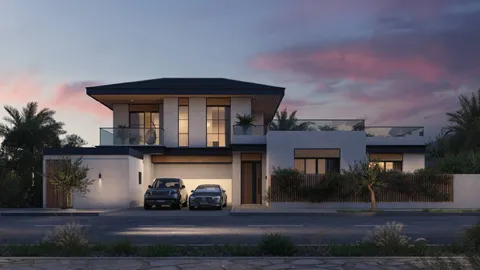
A twin villa is also one half of a joined pair, usually designed as a mirror image of its neighbour so the two read as a single building. In strict use, a twin is a pair built as one block on a joined plot, while semi-detached homes are two houses on two plots. Duet villa is another name for the same idea.
How UAE developers label them
In practice, the line between semi-detached and twin is not consistent across developers, and sometimes the same home is described both ways. It helps to see how real projects on the site are named.
- At DAMAC Islands 2 Twin Villas, DAMAC calls its five-bedroom pairs twin villas.
- Zaya names its pair at Lunaya The Dune, a duet villa, and we class it as twin.
- Expo City Dubai also uses duet villa at Yasmina Villas, and those homes are classed as semi-detached.
- Nakheel describes the paired homes at Bay Estate as attached villas, which we class as semi-detached.
- At Greenz, Danube offers a semi-detached villa and a twin villa as two separate types in the same project.
- Arada labels the villas at Dalia by type number: Type 1 is a semi-detached home and Type 2 a standalone one.
So "duet" can mean either, and "twin" and "semi-detached" overlap. On OffPlanVilla, each villa type is classed by its layout as the developer describes it, while its name keeps the developer's own words. The layout is what to compare, not the label.
How the types compare
The table sets out the practical differences in general terms. Any single project can differ, so treat it as a starting point for questions.
| Standalone | Semi-detached | Twin | Townhouse (not covered here) | |
|---|---|---|---|---|
| Shared walls | None | One | One | Two, or one at a row end |
| Open sides | Four | Three | Three | Front and back, plus one side at an end |
| Plot | Own plot, usually the largest | Own plot, beside the neighbour's | Often a joined plot, split between the pair | Narrow plot within a row |
| Natural light | Windows can face every way | Three façades | Three façades | Mostly front and back |
| Noise through walls | None from neighbours | Through one wall | Through one wall | Through two walls |
| Room to extend | Most, subject to approval | Less, and the pair should stay matched | Less, and the pair should stay matched | Least |
| Usual price for the size | Highest | Lower than a standalone | Close to semi-detached | Lowest |
Privacy, plot, light and noise
Privacy
A standalone villa puts space between you and every neighbour. A semi-detached or twin villa shares one boundary closely, which usually means a shared garden wall at the back as well as the shared house wall. Look at where the neighbour's windows, terraces and garden face.
Plot
The plot is where the types differ most. A standalone villa needs side passages on both sides, which can leave less usable garden than you expect on a narrow plot. A semi-detached villa trades one side passage for a shared wall, so the open land is concentrated on three sides. Our guide to plot size and built-up area explains how to work out the open land from the brochure.
Light
Light follows the façades. A standalone villa can have windows on all four sides, while a paired villa has three. The orientation of the plot matters as much as the type: a paired villa with its open side facing north or south can be brighter than a standalone villa hemmed in by close neighbours.
Noise
Noise through a shared wall depends on how the wall is built and on what sits against it. A layout that puts stairs, storerooms or wardrobes along the party wall keeps living rooms and bedrooms quieter. Ask for the floor plan of both halves.
Extensions and modifications
Buying a villa does not mean you can change its outside freely. In Dubai, Law No. 6 of 2019 on jointly owned real property covers master communities, including independent houses and land plots. Under Article 39, an occupant may make substantial changes to the structure or external appearance of a unit only after approval from the master developer, the Dubai Land Department and the competent authority.
If changes are made without approval, the occupant must put right any resulting damage at their own cost. In a paired villa there is a further practical point: the two halves are designed to match, so a change on one side affects how the pair looks from the street.
Other emirates have their own rules and approval routes. Wherever you buy, ask the developer for the community's design and modification rules before you plan a pergola, an extra room or a pool.
Maintenance and service charges
Every villa owner looks after the inside of the home and, usually, the garden. Shared roads, landscaping, security and facilities are paid for through service charges.
In a Dubai jointly owned community, the law sets each owner's share of the service charges by the ratio of the unit's area to the whole property, and the management entity may not collect any amount without approval from the Real Estate Regulatory Agency. The Dubai Land Department's Service Charge Index lets you look up the approved charges for a project by year.
A paired villa shares the party wall and sometimes a roof line with its neighbour. Ask whether repairs to shared elements are split between the two owners, and how.
Worked example: a standalone and a semi-detached villa
This example uses assumed figures, not real projects. The service charge rate is invented for the arithmetic and is not a market figure.
- Standalone: five bedrooms, built-up area 5,000 sq ft, plot 7,000 sq ft, price AED 9,000,000.
- Semi-detached: five bedrooms, built-up area 4,200 sq ft, plot 4,000 sq ft, price AED 6,300,000.
- Assumed service charge: AED 5 per sq ft of built-up area a year, for both.
| Standalone | Semi-detached | |
|---|---|---|
| Price per sq ft of built-up area | AED 1,800 | AED 1,500 |
| Price per sq ft of plot | AED 1,286 | AED 1,575 |
| Plot ÷ built-up area | 1.4 | 1.0 |
| Annual service charge at the assumed rate | AED 25,000 | AED 21,000 |
| Price difference | AED 2,700,000 more |
The semi-detached villa is cheaper per sq ft of house, by AED 300. The standalone villa is cheaper per sq ft of land, and it has 3,000 sq ft more plot. Which is better value depends on whether you are paying for the house or the land, which is why it pays to compare both. You can set real villas side by side on the compare page.
Resale considerations
Each type has its own pool of buyers. Standalone villas appeal to buyers who want the most privacy and land. Semi-detached and twin villas appeal to buyers who want villa living and a private garden at a lower entry price than a standalone home in the same community.
When you think about resale, compare like with like: a semi-detached villa against other semi-detached villas in the same community, not against standalone homes. Position within the community, such as a corner plot, a park view or a quiet street, often matters as much as the type. Five-bedroom villas come in all three layouts, so the 5 bedroom villas page is a useful place to compare them.
Where townhouses end and villas begin
OffPlanVilla covers villas only: standalone, semi-detached, twin, garden, waterfront, beachfront and branded villas. Townhouses are not listed, as set out on our methodology page. Where a project also sells townhouses, the villa page covers its villas and says so.
The working line is simple. A home that shares one wall, with one neighbour, is a semi-detached or twin villa. A home in a row of three or more, with neighbours on both sides, is a townhouse, and so is the end unit of that row, even though it has one open side.
The table below shows how the villa types on the site are classed, with recent examples of each.
| Villa type | Projects | Examples |
|---|---|---|
| Standalone | 124 | LEOS Royal, Mada'in Square, Dalia |
| Semi-detached | 11 | Dalia, Falcon Island South, Raiha |
| Twin | 11 | BRABUS Island Villas, Amara, Nawayef Village |
| Waterfront | 13 | BRABUS Island Villas, Jacob & Co. Beachfront Living, Y Views |
| Beachfront | 9 | BRABUS Island Villas, Ramhan Island Villas, Coral Beach Villas |
| Garden | 7 | The Brooks, The Greens, The Terraces |
| Branded | 9 | Fleurs de Jardin, Jacob & Co. Beachfront Living, Mira Villas |
This chart shows how many of the 161 verified villa projects offer each type.
How to check on a site plan
The site plan, also called the master plan or plot plan, shows every home in a phase from above. It is the most reliable way to see which layout you are buying.
- Find your plot number. Ask the developer for the exact plot, not just the type.
- Count the shared lines. A building outline with one shared edge is a pair. Two shared edges, or a long block of joined outlines, is a row of townhouses.
- Look at the plot boundaries. Two separate plots side by side suggest semi-detached. One plot split down the middle suggests twin.
- Check the neighbour's side. See which way the attached home faces and where its garden lies.
- Read the orientation. Note north and the position of roads, parks and the community's amenities.
- Compare with the floor plan. Match the shared wall on the site plan with the rooms behind it on the floor plan.
Checklist before you choose a type
- Is the home standalone, semi-detached, twin or in a row, according to the site plan?
- How many walls does it share, and which rooms sit against them?
- What is the plot size for this exact unit, and how much is open land?
- Which way do the open sides face?
- Is the neighbouring half the same design as yours?
- What are the community's rules on extensions, pergolas, pools and exterior changes?
- How are repairs to shared walls or roofs split?
- How are service charges worked out, and what is the approved budget?
- What do similar villas of the same type sell for in the same community?
You can browse villas by developer on our developers page and check each project's types on its own villa page.
Key terms
- Standalone villa: a detached house on its own plot with no shared walls. Also detached, independent or private villa.
- Semi-detached villa: one of two homes sharing a single wall, usually each on its own plot. Also attached villa.
- Twin villa: one of a mirrored pair designed as a single block, often on a joined plot.
- Duet villa: a developer's name for a paired villa, used for both semi-detached and twin layouts.
- Townhouse: a home in a row of three or more, sharing walls on both sides except at the ends.
- Party wall: the wall shared between two attached homes.
- Site plan: a plan from above showing every plot and building in a phase.
- Master developer: the developer responsible for the whole community, whose approval is needed for exterior changes in Dubai.